

Proximus nxt orchestrates the nxt level: innovation to create value and to defend it
Europe cannot choose between trusted AI at scale and sovereignty. It needs both, now.
A new level of intelligence: managing interdependence
The next level of intelligence is not AI alone; it is the intelligence of the systems connecting people, institutions and technologies. Three lessons show what this means for EU institutions:
- Shared governance. In 1954, twelve countries created CERN and built together what none could have built alone.² Our alliance works the same way: complementary partners, European governance and one accountable orchestrator, Proximus NXT.
- Human control over AI. Roger Penrose questioned whether computation alone explains human understanding.³ Today, Evo 2⁴ and Isomorphic Labs⁵ show AI accelerating discovery, while raising new questions of safety and control. Human judgement must stay in charge: the best AI, with decisions, data and encryption keys in European hands.
- Resilience under uncertainty. Edward Lorenz showed how small changes can have large consequences.⁶ One hidden dependency can disrupt critical services. That is why we map dependencies, test alternatives and design continuity across two sovereign regions, disconnected infrastructure and private cloud.
This is Relational Systems Intelligence: the ability to connect, govern and continuously reconfigure relationships to create value and strengthen resilience.
Why must ai defend against ai?
The technologies that create value must also help defend it.
According to Mandiant’s M-Trends 2026, vulnerabilities are being exploited, on average, before patches become available.⁷ AI-assisted detection, analysis and response are therefore increasingly essential, alongside human oversight.
And effective AI defence requires access to data at scale. Europe’s Action Plan on Cybersecurity and AI recognises the importance of advanced AI capabilities, including open models, for strengthening cyber defence.¹
The European Commission also warns that hybrid threats demand more than resilience: Europe must anticipate, defend and respond.⁸ As in nuclear safety, critical services need multiple, independent layers of protection, so that no single failure determines whether they survive.⁹
The optimal hybrid solution: innovation and sovereignty
Institutions face a difficult balance.
- Global hyperscalers offer scale, advanced data and AI capabilities and innovation speed. But data residency alone does not guarantee European operational control.
- European-only cloud providers offer full European control and growing AI infrastructure, but institutions also need a complete data, AI and cybersecurity ecosystem at scale.
- Proximus NXT brings both together. Our differentiation: we orchestrate European and global innovation under European ownership, operations and law. Sovereignty must never mean second-best. Controlled by Europe, not just located in Europe.
Proximus nxt: one ecosystem, one accountable partner
The European Commission selected the Proximus-led alliance in its Cloud III tender.¹⁰ Proximus NXT acts as the single point of contact: we design the architecture, coordinate the partners and technologies, and remain accountable for the service end to end.
Our ecosystem brings together partners with proven references:
- S3NS: a Thales-controlled sovereign cloud provider, offering SecNumCloud-qualified¹¹ infrastructure and services built on Google Cloud technology. Its data and AI ecosystem includes BigQuery for massive data analysis, Looker for insights and user adoption, and a growing range of advanced AI models. Trusted by EDF.
- Clarence: disconnected sovereign cloud infrastructure in Luxembourg, developed by Proximus and LuxConnect, for sensitive workloads and operational independence. Trusted by the CSSF and the CTIE.
- Mistral AI: for European AI models, alongside open-source models. Trusted by European financial institutions.
- Thales: cybersecurity and cyber defence capabilities, from encryption and identity protection to customer-controlled cryptographic keys. Trusted by ANS.
For our customers, this means one contract, one governance model and one accountable European partner, whatever the mix of technologies. It also means consolidated visibility over consumption, costs and technological dependencies, supporting financial control, informed decisions and long-term strategic autonomy.
Hybrid by design, the approach combines sovereign public cloud, disconnected infrastructure and private cloud operated by customers or Proximus. Open standards, model choice and portability help reduce lock-in and allow the ecosystem to evolve as new technologies and sovereignty requirements emerge.
Resilience is built into the architecture through redundancy across France and Germany, complemented by Clarence and private cloud as continuity options, with dedicated interconnect and European support. Critical workloads can be designed and tested to maintain essential operations under European control, even when external dependencies are disrupted.
Relational systems intelligence: from european capabilities to european value
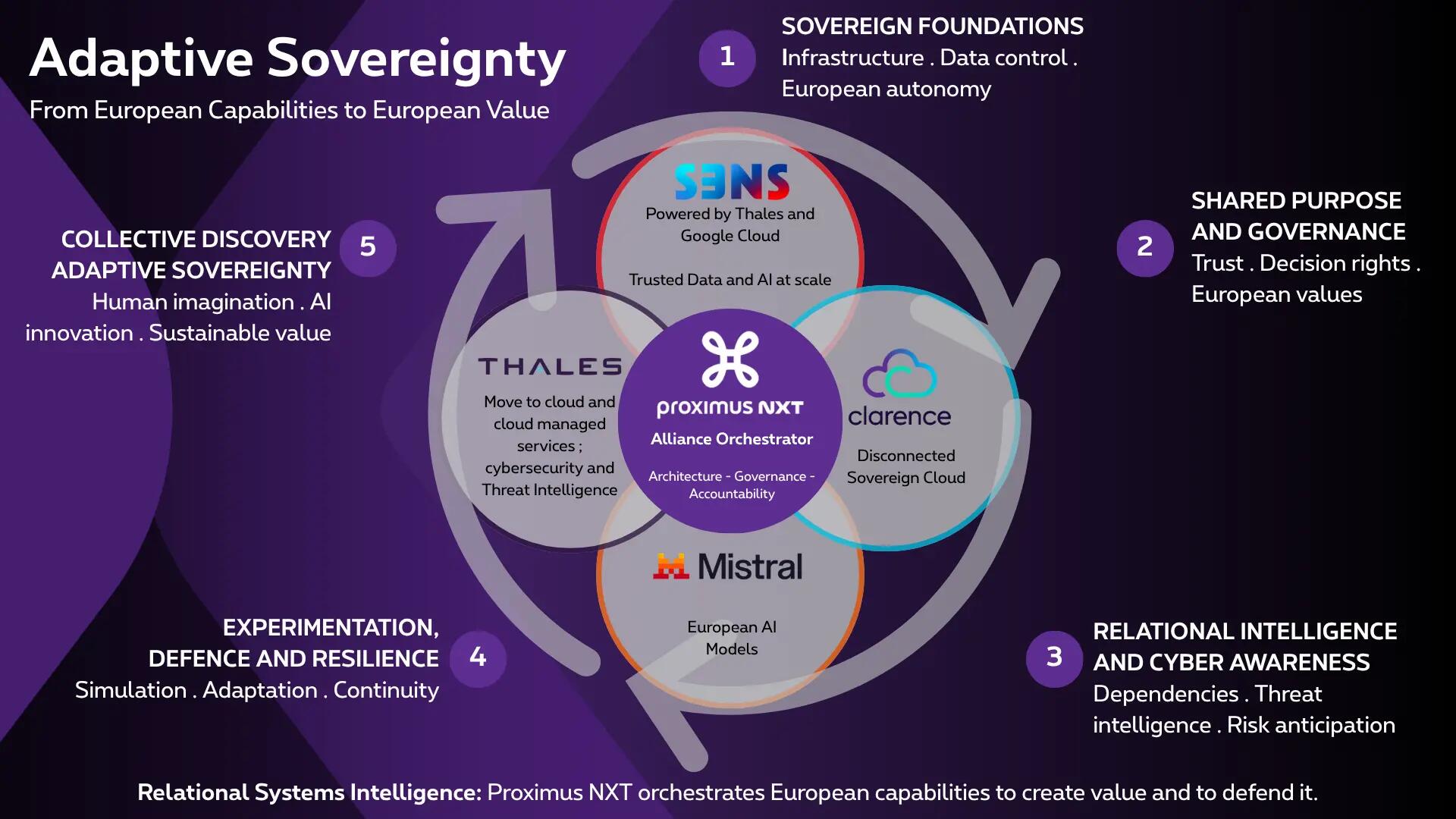
Sovereignty must be adaptive: it is tested over time, as technology, risks and institutional needs change. At the centre of our ecosystem, Proximus NXT orchestrates S3NS, Clarence, Mistral AI and Thales through five connected capabilities:
1. Sovereign foundations: infrastructure, data control and European autonomy.
2. Shared purpose and governance: trust, decision rights and European values.
3. Relational intelligence and cyber awareness: a cybersecurity incident reveals a hidden dependency, and threat intelligence helps anticipate the next risk.
4. Experimentation, defence and resilience: the architecture adapts, an alternative is tested and continuity is ensured.
5. Collective discovery and adaptive sovereignty: human imagination and AI innovation turn each lesson into sustainable value.
The process has no fixed beginning or end. As Roger Martin says, advantage comes from making distinctive choices about how value is created.¹²
So, to our opening question: yes, Europe can use the best AI to create value and defend it, and stay in control. It needs to control what matters, defend what is critical and bring together the best. Because sovereignty is not the absence of interdependence. It is the intelligence to govern it.
1. European Commission, EU Action Plan on Cybersecurity and Artificial Intelligence and press release, July 2026
2. CERN, Our History
3. Roger Penrose, The Emperor’s New Mind, 1989
4. Arc Institute, Evo 2, 2025
5. Isomorphic Labs
6. Edward N. Lorenz, “Deterministic Nonperiodic Flow”, Journal of the Atmospheric Sciences, 1963
7. Mandiant, M-Trends 2026
8. European Commission Joint Research Centre and Hybrid CoE, Defending Europe Against Hybrid Warfare, October 2026
9. IAEA, Safety of Nuclear Power Plants: Design, SSR-2/1 (Rev. 1)
10. European Commission, Cloud III procurement, 2026
11. ANSSI, list of SecNumCloud qualified providers
12. Roger L. Martin and A. G. Lafley, Playing to Win, 2013
